Why Your Car Jerks at Low Speed – Causes and Simple Fixes
Services and MOT

By Sanumotors Research
Tue Apr 28 2026
SHARE THIS ARTICLE
216 views
4 minutes read

Introduction
If your car jerks at low speed, it’s a clear sign something isn’t working correctly. Whether you're moving in traffic or slowly accelerating, this issue can indicate problems with fuel delivery, ignition, airflow, or even the transmission system.
At Sanu Motors, we regularly diagnose issues like engine hesitation, misfire at low RPM, and poor acceleration using advanced diagnostic tools and real-world road testing. In many cases, early detection can save you from costly repairs.
What Causes a Car to Jerk at Low Speed?
Low-speed jerking usually happens because the engine is not producing smooth, consistent power. This can be caused by:
- Uneven fuel delivery
- Poor combustion
- Air intake issues
- Transmission faults
Below are the most common causes explained in detail.
Fuel Injector Issue
A fuel injector issue is one of the leading causes of jerking. Injectors must spray fuel evenly; if they are clogged or faulty, the engine will struggle to maintain smooth performance.
Symptoms
- Engine hesitation
- Rough idle
- Poor fuel economy
- Misfire at low RPM
Fix
- Fuel system cleaning
- Injector testing and replacement
Engine Misfire at Low RPM
A misfire at low RPM happens when one or more cylinders fail to ignite properly.
Symptoms
- Jerking or shaking
- Loss of power
- Engine warning light
Fix
- Replace spark plugs
- Check ignition coils
- Run full diagnostic scan
Throttle Body and Air Intake Problems
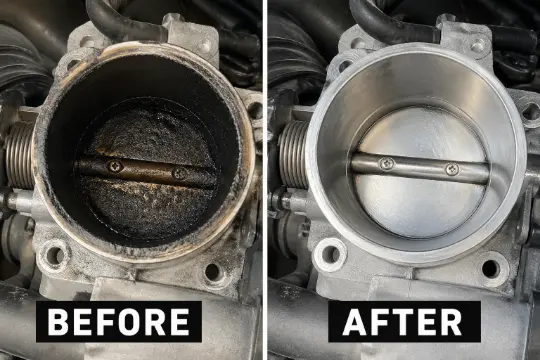
A dirty throttle body or faulty air sensor can cause engine hesitation, especially at low speeds.
Symptoms
- Delayed acceleration
- Rough idle
- Jerking when pressing the accelerator
Fix
- Throttle body cleaning
- MAF sensor cleaning or replacement
Poor Fuel Quality
Bad fuel can disrupt combustion and cause jerking.
Fix
- Drain contaminated fuel
- Refill with high-quality fuel
- Use fuel additives
Transmission Problems
Sometimes jerking comes from the gearbox, not the engine.
Symptoms
- Jerking during gear changes
- Delayed engagement
- Slipping gears
Fix
- Check transmission fluid
- Replace worn components
Faulty Sensors
Modern cars rely on sensors to control performance. If one fails, the engine may behave unpredictably.
Fix
- Scan for fault codes
- Replace faulty sensors
EGR Valve and DPF Issues (Diesel Vehicles)
Diesel vehicles often suffer from clogged EGR valves or DPF systems, especially in city driving.
Symptoms
- Jerking at low speed
- Loss of power
- Black smoke
Fix
- EGR cleaning
- DPF regeneration
How to Diagnose the Problem
To properly diagnose why your car jerks at low speed:
- Scan for fault codes
- Inspect ignition components
- Check fuel delivery system
- Monitor live engine data
- Perform a road test
At Sanu Motors, we combine diagnostics with real driving conditions to find the exact issue.
Simple Fixes You Can Try
- Use fuel injector cleaner
- Replace air filter
- Clean throttle body
- Check spark plugs
- Drive at higher RPM occasionally (for diesel vehicles)
When to Visit a Mechanic
You should seek professional help if:
- Jerking continues
- Engine warning light is on
- Power loss becomes noticeable
- Fuel consumption increases
Final Thoughts
A car that jerks at low speed is often an early warning sign. Whether it’s a fuel injector issue, engine hesitation, or misfire at low RPM, addressing the problem early can prevent expensive repairs.
Regular servicing and proper diagnostics are the key to keeping your vehicle running smoothly.
FAQ Section
Why does my car jerk when driving slowly?
A car jerks at low speed mainly due to fuel delivery issues, engine misfire, or air intake problems. It can also be caused by transmission faults or sensor failures.
Can dirty fuel injectors cause jerking?
Yes, clogged or dirty fuel injectors disrupt fuel flow, leading to uneven combustion and jerking at low speeds.
Is it safe to drive a car that jerks?
It is not recommended. Driving with jerking issues can worsen the problem and lead to expensive repairs, especially if caused by engine misfire.
How do I fix engine hesitation?
Engine hesitation can be fixed by cleaning the throttle body, replacing spark plugs, fixing fuel injectors, or repairing faulty sensors.
Can a clogged DPF cause jerking?
Yes, a blocked Diesel Particulate Filter restricts exhaust flow, causing loss of power and jerking, especially at low speeds.
SHARE THIS ARTICLE
216 views
4 minutes read
Comments
Loading...
Loading...
Categories
Featured Articles


Latest Articles


Most Viewed Articles

Sat Oct 19 2024
9582 views


Thu May 02 2024
3736 views